Market entry · October 2026
A strategic guide for nutraceutical brands, dietary supplement manufacturers, ingredient suppliers, and international companies seeking to enter India.
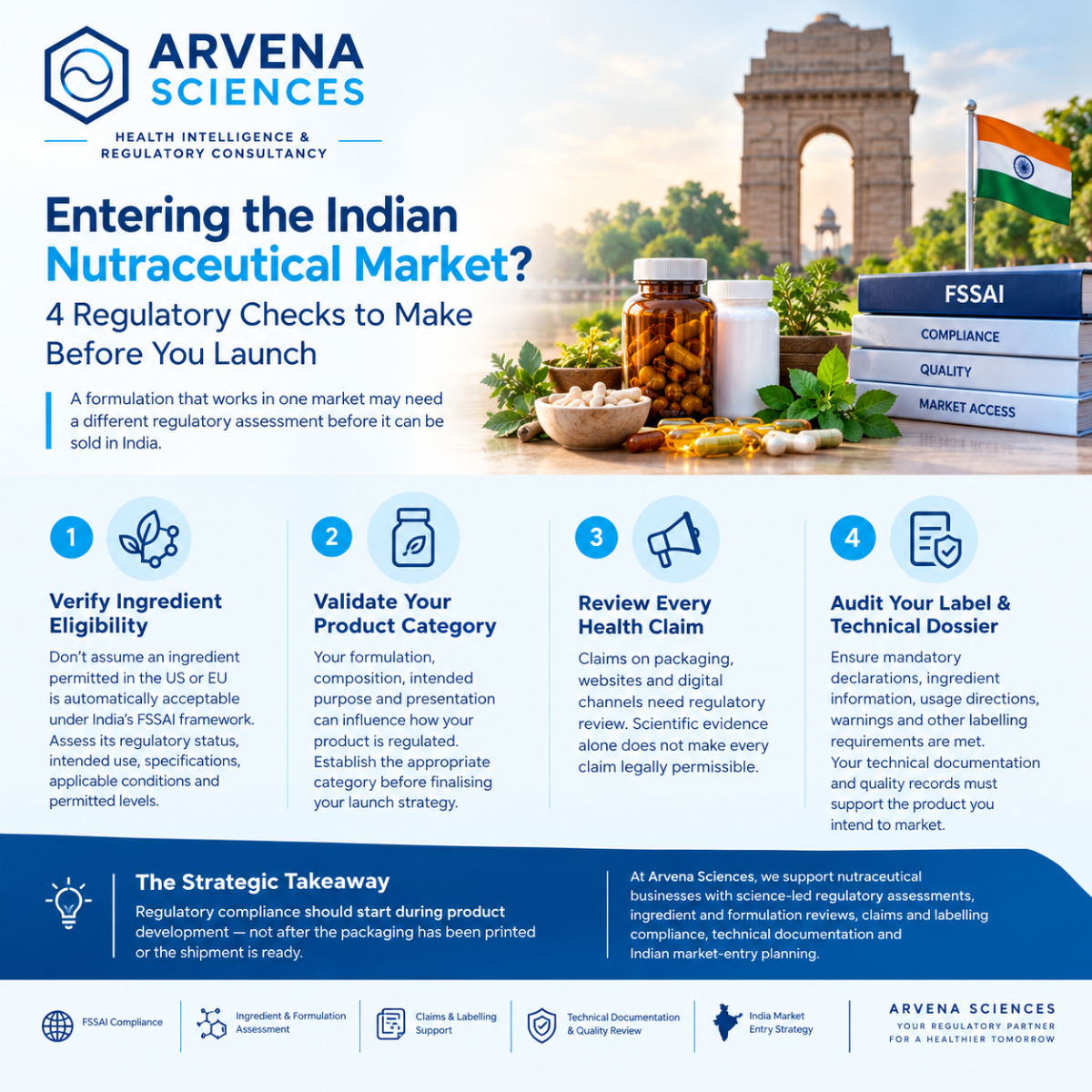
India is an increasingly attractive destination for nutraceuticals, health supplements, functional foods, vitamins, minerals, botanical extracts, probiotics, and science-backed wellness products. For businesses looking to enter this market, the opportunity is substantial—but commercial success requires more than an innovative formulation, an attractive label, and a strong distribution network.
The real challenge is entering the Indian market with a product that is scientifically defensible, correctly classified, compliant with applicable regulations, and commercially ready.
At Arvena Sciences, we help businesses approach nutraceutical market entry through a combination of regulatory intelligence, scientific documentation, formulation assessment, labelling compliance, and strategic regulatory advisory.
One of the most common mistakes in nutraceutical market entry is finalising the formulation and packaging before conducting a regulatory assessment.
An ingredient that is widely used in the United States or Europe may not automatically be acceptable for the same application, dosage, product category, or intended use in India.
Similarly, a botanical extract may require careful evaluation of its botanical identity, plant part, extraction method, standardisation, specifications, and applicable regulatory status.
Before committing to manufacturing, packaging, marketing, or distribution, businesses should establish:
A structured assessment at this stage can help identify regulatory obstacles before they become expensive commercial problems.
India regulates food products, including health supplements and nutraceuticals, through the Food Safety and Standards Authority of India (FSSAI) and the applicable food safety legislation and regulations.
The regulatory framework includes the Food Safety and Standards (Health Supplements, Nutraceuticals, Food for Special Dietary Use, Food for Special Medical Purpose, Functional Food and Novel Food) Regulations, 2016, together with applicable amendments, directions, and related requirements. Product classification and ingredient acceptability must be evaluated against the requirements in force at the time of launch.
Depending on the product's nature and intended use, the assessment may involve categories such as:
These categories are not interchangeable. The correct pathway depends on the actual product, its composition, intended purpose, and applicable regulatory provisions.
Novel or non-specified ingredients may require a separate assessment and, where applicable, prior approval. An FSSAI licence alone should not be assumed to establish the acceptability of every formulation or ingredient.
The practical takeaway is simple: determine the regulatory pathway before investing heavily in commercialisation.
Official reference: FSSAI — Health Supplements and Nutraceuticals
A formulation may look technically sound on paper yet encounter regulatory difficulties because of a single ingredient, an inappropriate plant part, an unsupported dosage, or an inadequately characterised extract.
A robust ingredient assessment should examine:
Ingredient identity and regulatory status: Verify the exact substance, source, form, and applicable regulatory listing or permission.
Daily usage level: Evaluate the proposed quantity against applicable limits and conditions of use. Where scientific evidence is relevant to establishing a permissible use level, ensure the supporting rationale is appropriate and documented.
Botanical specifications: Review the scientific name, plant part, extraction process, extract ratio where relevant, marker compounds, and quality specifications.
Safety and quality: Assess relevant toxicological information, contaminants, heavy metals, microbiological quality, residual solvents, stability, and other risk-based parameters.
Ingredient combinations: Consider interactions, cumulative exposure, compatibility, and suitability for the intended population.
Documentation: Maintain appropriate specifications, certificates of analysis, supplier documentation, safety evidence, and scientific references.
Ingredient compliance is not merely a documentation exercise. It is a fundamental part of product design and risk management.
In a competitive market, brands naturally want to communicate benefits such as immune support, digestive health, energy, metabolic health, cognitive performance, or healthy ageing.
However, the wording used on a label, website, marketplace listing, advertisement, or promotional brochure can have significant regulatory implications.
A claim that appears acceptable in one jurisdiction may be restricted or require a different level of substantiation in another.
For the Indian market, claims should be assessed under the applicable FSSAI requirements, including the Food Safety and Standards (Advertising and Claims) Regulations, 2018, as amended or otherwise applicable.
A sound claims review should establish:
For example, a general nutritional or physiological-function statement is not automatically equivalent to a disease-treatment claim. Scientific evidence alone also does not make every claim legally permissible.
The objective is to develop commercially meaningful claims that remain scientifically credible and regulatorily defensible.
Packaging is often the final step in a product-development project, but label compliance should be considered much earlier.
A nutraceutical label may need to address product identity, ingredient declarations, quantities, recommended usage, applicable warnings, target population, mandatory statements, manufacturer or importer details, and other requirements relevant to its category.
The exact requirements depend on the product and the regulations applicable at the time of sale.
A professional label review should consider:
A product can have a promising formulation and still face avoidable compliance risks because its packaging communicates the wrong category, overstates benefits, or omits mandatory information.
At Arvena Sciences, the objective is to align the formulation, technical dossier, claims, and label into a coherent regulatory strategy.
Regulatory readiness extends beyond the label.
Manufacturers and brand owners should evaluate the quality systems and technical documentation appropriate to their business model and applicable requirements.
Important areas include:
Businesses outsourcing production should also establish clear responsibilities between the brand owner, contract manufacturer, ingredient suppliers, and other relevant parties.
A reliable manufacturing partner is important, but outsourcing production does not eliminate the need to understand the regulatory responsibilities applicable to your own business.
For companies expanding from the United States, European Union, Saudi Arabia, or other international markets, India requires a product-specific regulatory assessment.
FDA-related dietary supplement documentation, EFSA-related scientific assessments, or SFDA-related registration records may provide useful supporting evidence. However, they do not automatically establish Indian regulatory acceptability.
Differences may arise in:
An efficient market-entry strategy identifies these differences before the product is adapted for India.
This is particularly important for imported finished products, proprietary formulations, novel ingredients, high-potency supplements, and products containing multiple active ingredients.
A structured market-entry programme typically follows six stages.
Stage 1 — Product feasibility assessment
Review the proposed formulation, intended use, target population, dosage, claims, and commercial objectives.
Stage 2 — Ingredient and classification review
Evaluate the regulatory status of each ingredient and determine the appropriate product category and regulatory pathway.
Stage 3 — Formulation gap assessment
Identify ingredient, dosage, safety, quality, specification, and documentation gaps that may require resolution.
Stage 4 — Claims and labelling review
Assess the proposed label, consumer instructions, warnings, claims, and digital marketing content.
Stage 5 — Technical dossier preparation
Organise the applicable formulation records, ingredient specifications, certificates of analysis, scientific substantiation, quality documentation, and other supporting material.
Stage 6 — Market-readiness review
Evaluate the applicable licensing, approval, notification, manufacturing, import, and post-market obligations before commercial launch.
The sequence may vary depending on the product and business model. Novel ingredients or other regulatory uncertainties should be addressed early rather than left until the final stage.
Entering India should be approached as a regulatory and commercial planning exercise—not simply as an application-filing process.
Arvena Sciences — Health Intelligence & Regulatory Consultancy supports nutraceutical and health supplement businesses through structured regulatory and scientific advisory services.
Our support can include:
Our approach is to identify regulatory issues early, clarify documentation requirements, and help businesses make informed decisions before committing to commercial launch.
The precise scope, timelines, and deliverables depend on the product, the evidence available, the applicable regulatory pathway, and the requirements of the relevant authority.
Whether you are launching a new supplement brand, importing an established international product, developing a botanical formulation, or expanding your manufacturing portfolio, a product-specific regulatory assessment is a practical first step. Before finalising your formulation or packaging, let us evaluate the regulatory questions that matter most to your launch.
Disclaimer: This article provides general regulatory information and is not a substitute for a product-specific assessment or legal advice. Regulatory requirements, ingredient permissions, claims, and approval pathways should be verified against the latest applicable legislation, official notifications, and directions before making commercial decisions.
 Arvena